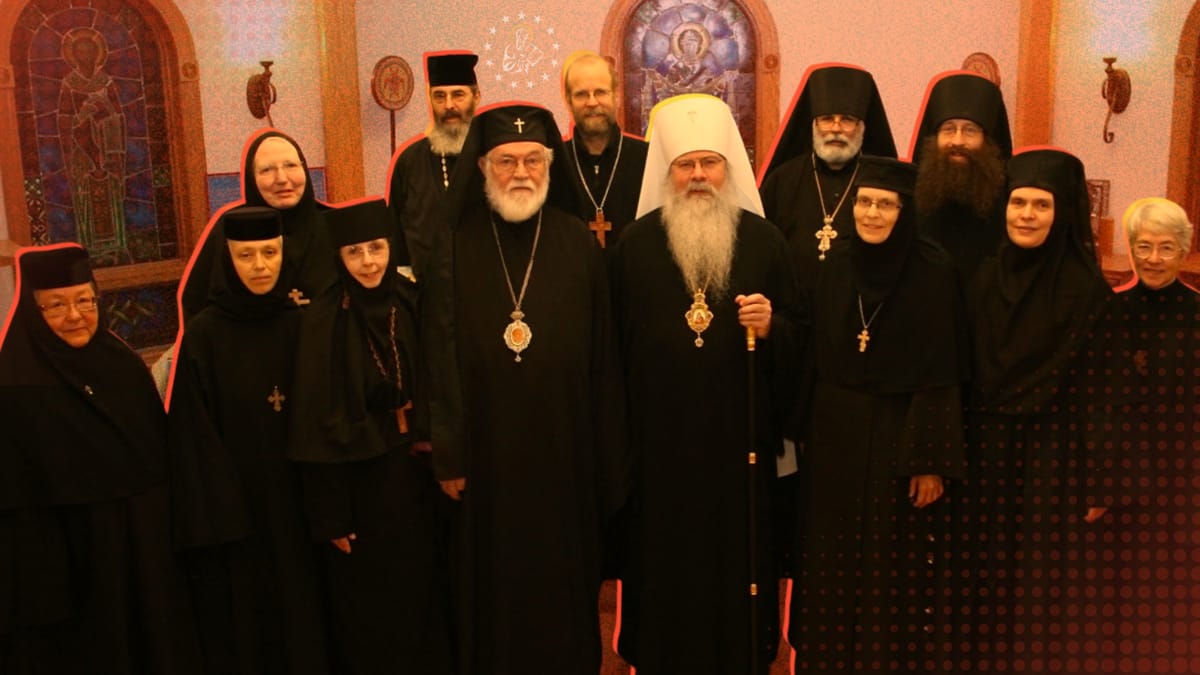
Proud to have contributed for this article the photograph of the Synaxis of Monastic Superiors of the Orthodox Church in America (© 2016, Ralph H. Sidway, All Rights Reserved. Digital manipulation by the editors.)
The Rise of American Monasticism
by Roman Roberts, Oct. 5, 2026, Union of Orthodox Journalists
From its early foundations to its growing presence in American Orthodoxy today
Just a century ago, Orthodox monastics were a rarity in America. Today, there are over 70 monasteries across jurisdictions in over 20 states, giving many Orthodox Christians hope for the future of monasticism in the country. History has shown many times that our monasteries are a blessing and place of spiritual strengthening for Orthodox laity, and America has an opportunity for a new kind of growth with the recent, ongoing wave of converts.
Orthodox monasticism in America began with the establishment of Saint Tikhon’s Monastery in Pennsylvania [in 1905]. Initially, it was home to an immigrant group of monks at the beginning of the 20th Century, but quickly became a place of refuge for Father Arseny’s monks and a theological seminary. Later in the mid-20th Century, Holy Trinity Monastery in Jordanville followed a similar path after its founding by former monks of the Pochaev Lavra in Western Ukraine who had fled during the Bolshevik Revolution. The current temple’s construction was finished in 1949, and the monastery was led by Father Panteleimon, who himself had previously been a monk of Saint Tikhon’s. Of the current 80 Orthodox monasteries in America, these were two of the only five monasteries founded before 1950.
Decades later, a small wave of converts without any ethnic investment in the faith led to the establishment of new parishes and monasteries across the country. In the 80s, the number of Orthodox monasteries more than doubled with the establishment of sixteen new communities. By 1989, our monasteries reached thirty. The angelic life had become more than the lifestyle of particular immigrants. It had become the choice of American converts like Mother Brigid (today, Abbess Brigid), named such by Saint Seraphim of Platina who tonsured her a nun. Purposely, she was given the name “Brigid” to reflect the understanding that Orthodoxy is not simply a relic of ethnic origins, but the faith of the Apostles, which is to be spread to all nations.
For many, one visit is the beginning of their vocation as a monastic, but even if this does not happen, it is at least a gift of great stillness.
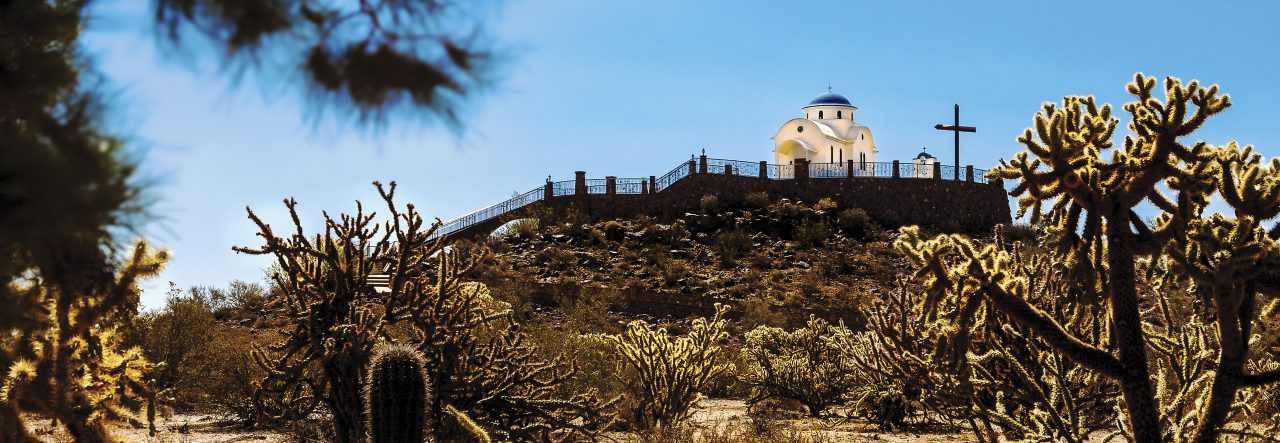
One cannot reflect on the growth of monasticism in America without mentioning the great Greek boom led by Elder Ephraim. Saint Anthony’s Monastery, often called Athos of America, is the jewel of the Sonoran Desert. What started as a small spiritual outpost for six Athonite monks in 1995 is now the largest monastic community in the Western Hemisphere. Over 3 decades Elder Ephraim established over 17 monasteries across the United States and Canada which continue to grow even after his repose in 2019.
Today, our 80 monasteries are home to well over 500 monks, nuns and novices. Though the Orthodox population is quite small nationally, still about 1%, the current and ongoing state of Orthodox monasteries in America tell us that the faith is now firmly rooted. Many are aware of the alarm that the current “convert surge” has caused secular and religious news outlets and personalities despite our small number. Due to its rigor and seriousness with which it takes itself, the faith cannot be considered a fad or trend even by opponents of the Church. Because the wave is mostly young, monasteries have a great opportunity.
There is no age limit for becoming a novice, but it has often been said that younger persons have less difficulty giving up decades long habits, as well as possessions, careers, relationships, comforts, and many other aspects of life “in the world.” Conversely, youth does not necessarily make one suited for monastic life. Our monasteries have a large pool of potential strugglers in the parishes. Many have already begun to consider becoming novices at nearby monasteries.
Orthodoxy, especially monastic life, cannot be attained or understood through a proxy like a book or a screen, only through lived experience.
Holy Cross Monastery in Wayne, West Virginia has more than doubled in a decade. With the construction of its new temple, pilgrim numbers have grown higher than ever before. In February of 2025, the Antiochian Archdiocese announced the opening of a new monastery in Grand Junction Tennessee, dedicated to the Life Giving Trinity, and to be led by Hieroshcemamonk Paul. The hope is to build an Athonite monastic presence in the Midsouth. In January of 2026 at the Synaxis of the Holy Archangel Monastery (Monastery New Marcha), Mother Paraskeva was installed as abbess by His Grace Irinej of Washington, New York, and Eastern America. Another durable community for women seeking to devote themselves to Christ can now be built in Ohio.
We who are already in the Church must also “come and see.” This great rise of monasticism in America only happened because the faithful “showed up.” Novices, abbots, abbesses, the priests, the priestmonks, and the laity devoted themselves to Christ. If you’re a convert or even a lifelong Orthodox Christian, visit your local monastery for a week, weekend, or even one day when they are open to visitors. Be attentive and take the opportunity to slow down and forget the world. Attend the services and do whatever work is given to you by the monks and nuns. Orthodoxy, especially monastic life, cannot be attained or understood through a proxy like a book or a screen, only through lived experience. For many, one visit is the beginning of their vocation as a monastic, but even if this does not happen, it is at least a gift of great stillness. Even a small sisterhood or brotherhood can serve as a blessing for those who seek it.
LINK to the full article: https://uoj.news/history-and-culture/the-rise-of-american-monasticism/

